On World Art Day 2026, we celebrate not just art — we celebrate the kind of curious, fearless mind that schools like ours work every day to nurture.
Imagine a student who loved painting, but also sketched flying machines in his notebook. Who studied the human body with the same passion he brought to landscapes. Who never stopped asking “why?” — and turned that question into a life’s work.
That student was real. His name was Leonardo da Vinci.
Born over 570 years ago in a small Italian town, Leonardo da Vinci was a painter, engineer, architect, inventor, and student of all things scientific. His story is more than history — it is a blueprint for what happens when curiosity meets hard work.
At International School Guwahati, we believe that every child carries a spark of this kind of genius. This World Art Day 2026, let us explore the life and legacy of the man whose very birthday — April 15 — is celebrated globally as.
When Is World Art Day 2026?
World Art Day 2026 is celebrated on April 15 to mark the birthday of Leonardo da Vinci, one of history’s greatest artists and thinkers. His legacy symbolizes creativity, innovation, and the deep connection between art and science.
World Art Day was established by UNESCO in 2011 to promote awareness of creative activity worldwide and to honor the legacy of Leonardo da Vinci, whose birthday falls on this day. Each year, World Art Day celebrations help reinforce the links between artistic creations and society, encourage greater awareness of the diversity of artistic expressions, and highlight the contribution of artists to sustainable development.
Choosing April 15 as World Art Day was no accident. It was a deliberate tribute to a man who proved, centuries before modern education theory, that art and science are not opposites — they are partners.
Who Was Leonardo da Vinci?
Leonardo da Vinci, properly named Leonardo di ser Piero da Vinci (“Leonardo, son of ser Piero from Vinci”), was born on 15 April 1452 in, or close to, the Tuscan hill town of Vinci, Italy. Although he had no formal academic training, many historians and scholars regard Leonardo as the prime exemplar of the “Universal Genius” or “Renaissance Man,” an individual of “unquenchable curiosity” and “feverishly inventive imagination.” He is widely considered one of the most diversely talented individuals ever to have lived.
What makes his story especially compelling for students is where it began.
The Early Life of Leonardo da Vinci: Born Curious, Not Privileged
He was born out of wedlock, which meant he couldn’t follow his father into the family business. Since he couldn’t attend the formal schools of Florence, he was forced to learn by observing nature and tinkering. That is a detail worth sitting with. The greatest genius in recorded history was, in many ways, an outsider. He did not have access to elite education. What he had was something no school can give and no syllabus can take away: a burning desire to understand the world around him.
Da Vinci received no formal education beyond basic reading, writing, and math, but his father appreciated his artistic talent and apprenticed him at around age 15 to the noted sculptor and painter Andrea del Verrocchio of Florence. For about a decade, da Vinci refined his painting and sculpting techniques and trained in mechanical arts.
From that apprenticeship, one of history’s most remarkable careers was launched.
Leonardo da Vinci Art: Masterpieces That Changed the World
When most people think of Leonardo da Vinci art, two masterpieces come to mind immediately.
The Mona Lisa — arguably the world’s most famous painting — was begun in 1503 when da Vinci received a commission from Francesco del Giocondo to paint his wife. More than five centuries later, it still draws millions of visitors to the Louvre in Paris each year.
The Last Supper — a mural painted between 1495 and 1498 — captures the dramatic moment Jesus announces that one of his disciples will betray him. His Last Supper and Mona Lisa are among the most widely popular and influential paintings of the Renaissance.
But Leonardo da Vinci art pieces go far beyond these two icons. He painted The Virgin of the Rocks, Lady with an Ermine, and the deeply spiritual St. John the Baptist. He created the Vitruvian Man — that now-famous sketch of a human figure inscribed in a circle and square, exploring the mathematical proportions of the human body.
Leonardo sought a universal language in painting. Using perspective and his experiences with scientific observation, Leonardo tried to create faithful renditions of life. This call to objectivity became the standard for painters who followed in the 16th century.
The Inventor: Centuries Ahead of His Time
Here is where the story becomes almost unbelievable.
Leonardo da Vinci (1452–1519) was an Italian polymath, regarded as the epitome of the “Renaissance Man,” displaying skills in numerous diverse areas of study. While most famous for his paintings such as the Mona Lisa and the Last Supper, Leonardo is also renowned in the fields of civil engineering, chemistry, geology, geometry, hydrodynamics, mathematics, mechanical engineering, optics, physics, pyrotechnics, and zoology.
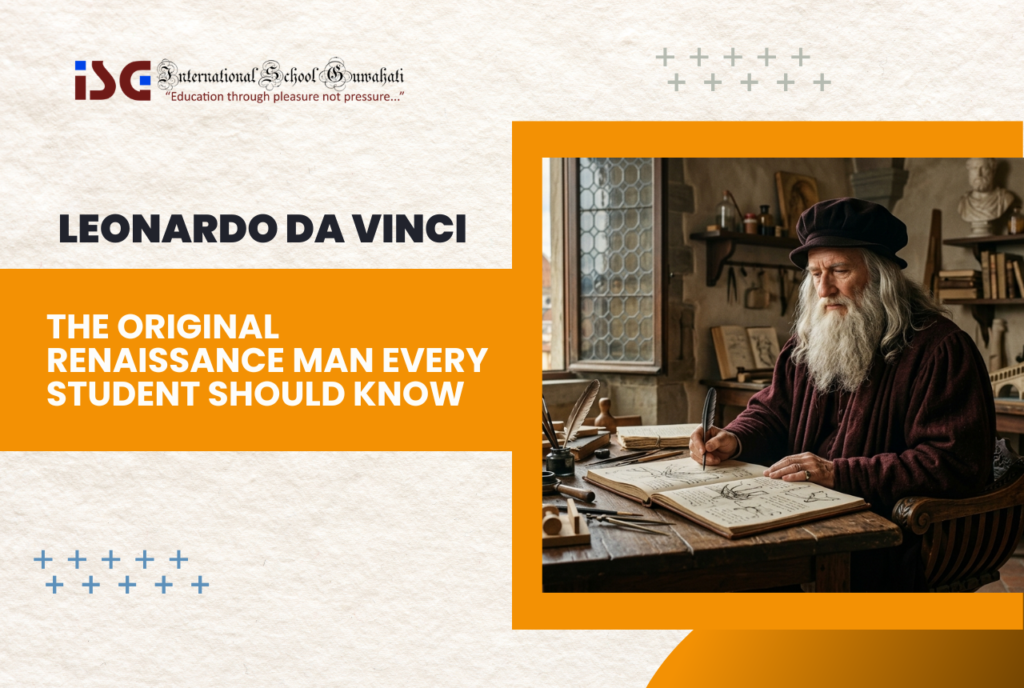
In his private notebooks — filled with sketches in his famously left-handed mirror script — da Vinci studied nature, mechanics, anatomy, physics, architecture, weaponry and more, often creating accurate, workable designs for machines like the bicycle, helicopter, submarine and military tank that would not come to fruition for centuries.
He also designed a robotic knight, a self-propelled cart, a leather diving suit, and a more accurate version of an anemometer to measure wind speed.
Think about what this means. A man living in the 1400s and 1500s designed a helicopter. He imagined a submarine. He sketched a concept for what would eventually become the bicycle. The world simply was not ready for his ideas yet.
His famous notebooks, filled with sketches, inventions, and backwards handwriting (mirror writing), are historical treasures. The Codex Leicester, one of his most famous, was bought by Bill Gates in 1994.
What Made Leonardo da Vinci Truly Different?
Many talented people study art. Many brilliant people study science. What made Leonardo extraordinary was that he refused to treat them as separate things.
He saw science and art as complementary rather than distinct disciplines, and thought that ideas formulated in one realm could — and should — inform the other.
This is a lesson that resonates deeply with the philosophy at International School Guwahati. A truly well-rounded education — one that blends academics with arts, sports, and creative exploration — prepares students not just for exams, but for life. Leonardo’s story proves that some of history’s greatest breakthroughs come from people who were never told to stay in one lane.
His natural genius crossed so many disciplines that he epitomized the term “Renaissance man.” Largely self-educated, he filled dozens of secret notebooks with inventions, observations and theories about pursuits from aeronautics to human anatomy.
Leonardo’s Legacy: What Schools Can Learn From Him
What should students take away from the story of Leonardo da Vinci?
1. Curiosity is the most powerful learning tool. Leonardo did not wait to be taught everything. He observed birds in flight. He dissected human bodies to understand anatomy. He watched water flow to understand hydrodynamics. He let questions drive him.
2. Failure is part of the process. As he would throughout his life, Leonardo set boundless goals for himself — one is tempted to call it a grandiose “unfinished symphony.” Many of his projects were never completed. He did not see this as defeat. He saw it as exploration.
3. Art and science belong together. The modern world often pushes students to choose between the humanities and the sciences early. Leonardo’s life is proof that the most original minds resist that choice.
4. Observation matters more than memorization. Leonardo’s scientific process was based mainly upon observation. His practical experiments are also founded in observation rather than belief.
These are values that shape the curriculum and culture at International School Guwahati — where students are encouraged to question, create, and explore across disciplines.
Celebrating World Art Day 2026 in Your School
World Art Day 2026 encourages people to explore the same spirit of curiosity and innovation that Leonardo embodied. In classrooms, studios, and digital platforms, young artists are redefining expression and pushing boundaries.
Here are some meaningful ways students can celebrate on April 15, 2026:
- Sketch an invention — Draw a machine or device that solves a problem you notice in daily life, just as Leonardo did.
- Recreate a masterpiece — Try your hand at the Vitruvian Man, or recreate the composition of the Mona Lisa with a classmate as the subject.
- Write a “notebook entry” — Keep a journal for one week where you observe and draw one thing from nature each day.
- Hold a classroom debate — Is art more important than science, or are they equal? Let Leonardo’s life be your starting point.
- Explore world art — Visit Google Arts & Culture to view Leonardo’s original works in stunning detail, for free.
Conclusion: The Genius in Every Student
Leonardo da Vinci died in 1519, reportedly lamenting that his work had not reached the quality it should have. Despite all that he did, he carried some feelings of inadequacy to the grave — saying, “I have offended God and mankind because my work did not reach the quality it should have.”
The man who painted the Mona Lisa, designed the helicopter, and mapped the human body thought he could have done more.
That humility — that drive to always learn, always grow, always reach further — is perhaps the most important lesson Leonardo has to teach young people today.
At International School Guwahati, we celebrate that spirit every single day. Through art classes, science labs, music programs, sports, and beyond, we believe that a great education is one where every student has the chance to discover what kind of genius lives inside them.
This World Art Day 2026, take a moment to look at the world the way Leonardo did — with open eyes, an open mind, and the courage to ask: “What if?”
Frequently Asked Questions (FAQ)
Q1. Who was Leonardo da Vinci?
Leonardo da Vinci (1452–1519) was an Italian polymath — a painter, sculptor, engineer, architect, scientist, and inventor. He is widely regarded as one of the most talented and curious people in human history, best known for painting the Mona Lisa and The Last Supper.
Q2. What is the early life of Leonardo da Vinci?
Leonardo was born on April 15, 1452, near the town of Vinci in Tuscany, Italy. Born out of wedlock, he could not access formal elite education, so he taught himself by observing nature. At around age 15, he was apprenticed to the renowned painter Andrea del Verrocchio in Florence, where he developed his extraordinary skills in painting and sculpture.
Q3. What are the most famous Leonardo da Vinci art pieces?
His most iconic works include the Mona Lisa, The Last Supper, Vitruvian Man, Lady with an Ermine, and The Virgin of the Rocks. He also produced thousands of pages of drawings covering anatomy, engineering, botany, and more.
Q4. What inventions did Leonardo da Vinci design?
Leonardo conceptualized the helicopter, parachute, armored tank, submarine, bicycle, robotic knight, diving suit, and solar power concentrator — all centuries before they became reality. He documented these in private notebooks written in mirror script.
Q5. Why is World Art Day celebrated on April 15?
World Art Day is observed every year on April 15 because it is Leonardo da Vinci’s birthday. The date was chosen by the International Association of Art (IAA) and recognized by UNESCO to honor his legacy as a symbol of creativity, peace, and interdisciplinary excellence.
Q6. How can schools celebrate World Art Day 2026?
Schools can organize art exhibitions, sketching competitions, science-art crossover projects, nature journaling sessions, and discussions about famous artists. At International School Guwahati, World Art Day is a wonderful opportunity to celebrate the creativity in every student.
Q7. Why is Leonardo da Vinci important for students today?
His life teaches that curiosity, observation, and the willingness to cross boundaries between subjects are more valuable than any single skill. He is proof that a well-rounded education — combining arts, science, and critical thinking — produces the world’s most original minds.