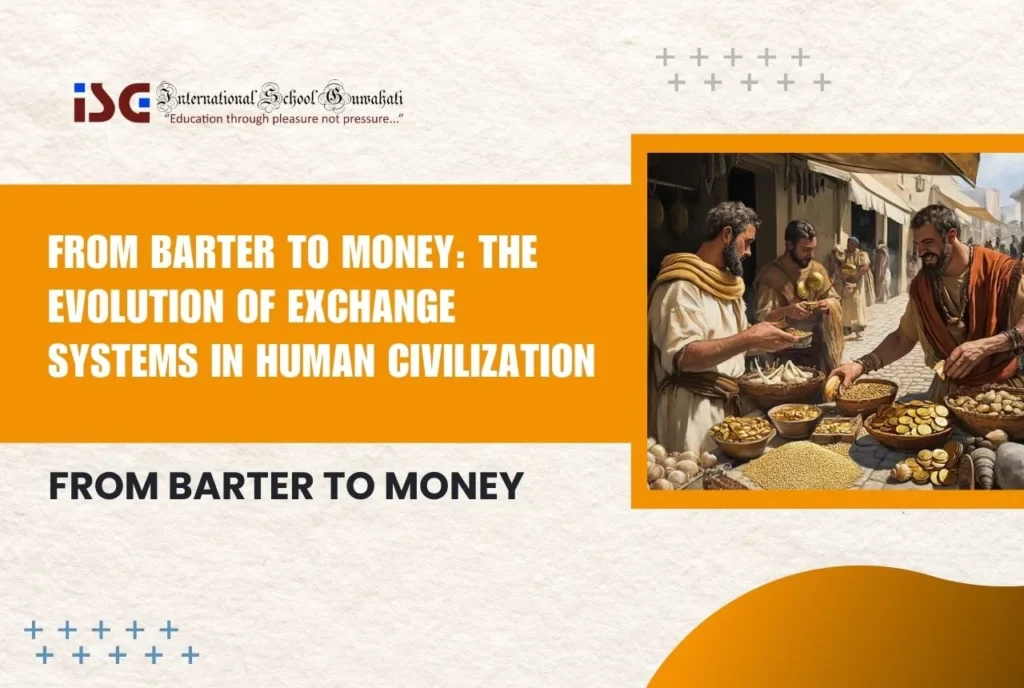
Explore the journey from barter to money, understand the barter system of exchange, its history, advantages and disadvantages of bartering, and learn through real examples like Jonbeel Mela. A detailed guide on the evolution of trade systems.
Introduction
The journey from barter to money represents one of the most significant transformations in human economic history. Long before coins, currency notes, and digital payments existed, people relied on direct exchange systems to meet their daily needs. This early form of trade laid the foundation for modern economies.
Understanding what is the barter system of exchange, its origins, its evolution, and why societies eventually transitioned from barter to money provides valuable insights into how economic systems develop over time.
Even today, remnants of the barter system can still be observed in traditional communities and cultural events such as Assam’s famous Jonbeel Mela, where people continue to exchange goods without using money.
This blog explores the barter system history, its working mechanism, and the advantages and disadvantages of bartering, while explaining why money ultimately became the dominant medium of exchange.
What Is the Barter System of Exchange?
To understand the transition from barter to money, it is essential to first define what is the barter system of exchange. The barter system is an economic arrangement where goods and services are directly exchanged for other goods and services without using money as an intermediary.
For example, a farmer might exchange rice for vegetables grown by another farmer. In this system, value is determined mutually by the parties involved. The barter system of exchange can be explained as a simple yet restrictive form of trade that requires a “double coincidence of wants”—both parties must want what the other has to offer at the same time.
Historically, the barter system was the earliest method of trade, especially in small communities where people produced limited varieties of goods. While the barter system of exchange seems straightforward, it had several practical challenges that later led societies from barter to money.
Barter System History: Origins and Early Use
The barter system history dates back to ancient civilizations, long before written records were maintained. Archaeological evidence suggests that early humans exchanged food, tools, and livestock to survive. The barter system history is closely linked with subsistence economies, where communities produced what they needed and traded surplus goods.
In ancient Mesopotamia, Egypt, and the Indus Valley, barter played a crucial role in local trade. The barter system history shows that goods like grains, cattle, salt, and metals were commonly exchanged. Over time, standardized barter commodities such as grain or shells began to emerge, foreshadowing the invention of money.
Despite its limitations, the barter system history proves that barter was an essential stepping stone in the evolution from barter to money, enabling early economic cooperation and specialization of labor.
How the Barter System Works
The barter system operates on direct negotiation between two parties. The value of goods or services is subjective and depends on individual needs. For instance, a potter might exchange pots for grains, while a fisherman might trade fish for tools.
However, the barter system suffers from several inefficiencies. One of the biggest challenges is the lack of a common measure of value. Another issue is indivisibility—certain goods cannot be divided without losing value. These inefficiencies explain why societies gradually moved from barter to money as economies became more complex.
Despite these challenges, the barter system remains relevant in limited contexts, especially in rural and traditional settings.
Jonbeel Mela: A Living Example of the Barter System
A remarkable real-world example of the barter system is the Jonbeel Mela held annually in Assam, India. This centuries-old fair beautifully demonstrates what is the barter system of exchange in practice.
At Jonbeel Mela, tribal communities exchange agricultural produce, handmade items, fish, and forest goods without using money. This event reflects the cultural significance and historical relevance of barter. The fair offers a rare opportunity to witness the barter system history in a modern context.
Jonbeel Mela highlights how barter is not merely an outdated concept but a cultural tradition that reinforces community bonding. It also serves as an educational model to understand the transition from barter to money and why money became necessary beyond such limited settings.
Why Societies Moved from Barter to Money
As trade expanded beyond small communities, the limitations of the barter system became increasingly evident. The need for a common medium of exchange led societies from barter to money.
Money solved several key problems of barter:
- It provided a standard unit of value
- It acted as a store of value
- It enabled deferred payments
- It simplified trade across regions
The shift from barter to money allowed markets to grow, encouraged specialization, and supported long-distance trade. Without this transition, modern economies would not have been possible.
Advantages and Disadvantages of Bartering
Understanding the advantages and disadvantages of bartering is crucial to appreciating why barter declined and money emerged.
Advantages of Bartering
One of the primary advantages and disadvantages of bartering is that barter does not require money. This makes it useful in cash-scarce economies. Other benefits include:
- Promotes direct exchange
- Encourages community interaction
- No inflation or interest
- Useful during economic crises
The advantages and disadvantages of bartering also show that barter can reduce dependency on formal financial systems, especially in rural areas.
Disadvantages of Bartering
Despite its benefits, the advantages and disadvantages of bartering clearly highlight its weaknesses:
- Double coincidence of wants
- No standard measure of value
- Difficulty in storing wealth
- Limited scalability
These disadvantages ultimately pushed economies from barter to money, enabling faster, more efficient trade.
Barter System vs Modern Monetary System
Comparing the barter system with modern monetary systems highlights the importance of money. While barter relies on mutual needs, money allows individuals to trade with anyone, anytime.
The barter system history shows that barter was effective in simple economies but failed to support complex trade networks. This comparison further explains the natural progression from barter to money.
Relevance of Barter in the Modern World
Although money dominates today’s economies, the barter system has not entirely disappeared. Corporate barter, online barter platforms, and traditional fairs like Jonbeel Mela continue to keep barter alive.
In times of economic instability, the advantages and disadvantages of bartering are reassessed, and barter often resurfaces as a temporary alternative. This proves that understanding what is the barter system of exchange remains relevant even in the digital age.
Conclusion: From Barter to Money- A Necessary Evolution
The evolution from barter to money was not sudden but gradual, shaped by the growing needs of societies. While the barter system played a vital role in early human development, its limitations made money inevitable.
By examining what is the barter system of exchange, exploring the barter system history, and understanding the advantages and disadvantages of bartering, it becomes clear why money emerged as a superior medium of exchange. Cultural examples like Jonbeel Mela remind us of barter’s historical and social significance, even as we operate within modern monetary economies.
The journey from barter to money ultimately reflects humanity’s ability to adapt, innovate, and build increasingly sophisticated economic systems.