Imagine a classroom where a student in Guwahati collaborates on a science project with peers in real time, submits assignments digitally, and receives instant feedback from their teacher — all without opening a single textbook. That is the promise of the digital classroom, and it is no longer a vision of the future. It is happening right now.
Whether you are a parent exploring modern schools for your child, a student curious about tech-enabled learning, or an educator looking to upgrade your teaching methods, this guide answers everything you need to know about the digital classroom — what it is, which tools power it, and how leading schools like International School Guwahati (ISG) are putting it into practice.
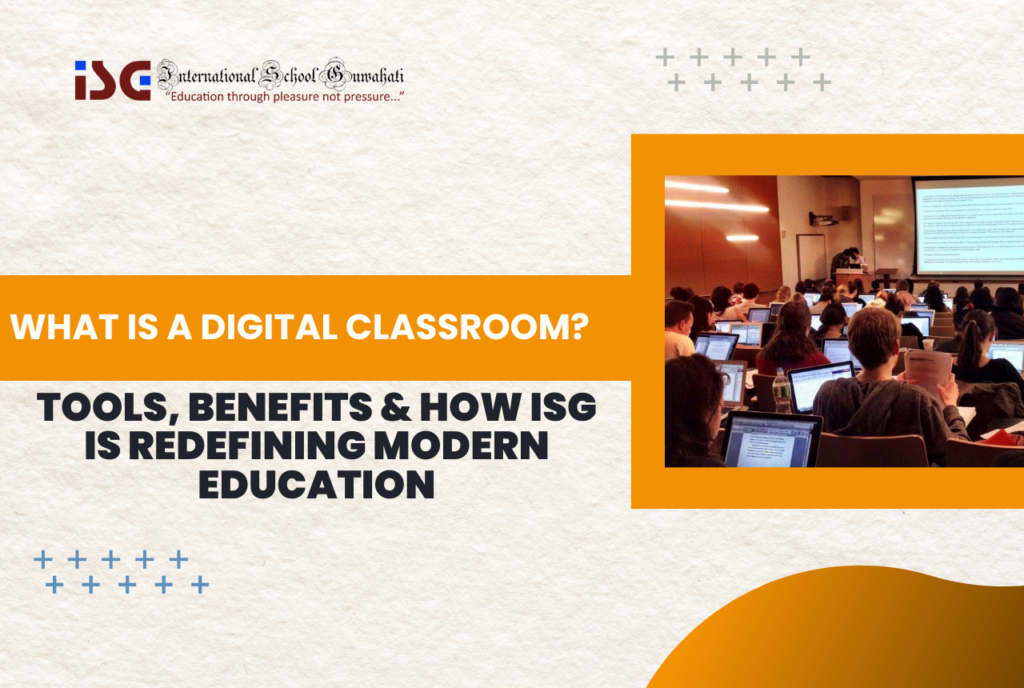
What Is a Digital Classroom?
A digital classroom is a technology-enabled learning environment where teaching and learning activities are supported — or entirely conducted — through digital devices, software, and the internet. Unlike traditional classrooms that rely primarily on chalk boards and printed textbooks, digital classrooms integrate:
- Interactive smart boards and projectors
- Learning management systems (LMS)
- Cloud-based collaboration tools
- AI-powered personalised learning platforms
- Digital assessment and feedback systems
The result is an immersive, flexible, and data-driven learning experience that can happen inside a school building, at home, or anywhere with an internet connection.
Why Digital Classrooms Matter in 2026
The shift toward digital education is not a trend — it is a structural change in how the world learns. Here is why digital classrooms are essential for students today:
1. Personalised Learning Paths
AI-powered platforms in digital classrooms can adapt content to each student’s pace, strengths, and learning style — something a single teacher managing 40 students cannot do manually. Students who grasp concepts quickly can move ahead; those who need more support get targeted help instantly.
2. Access to Global Resources
Digital classrooms break geographical barriers. A student in Guwahati, Assam, can access the same quality of educational videos, simulations, and research databases as a student in Delhi or Singapore. This democratisation of learning is especially powerful for students in Northeast India.
3. Preparation for a Digital-First World
Students who learn in digital environments develop 21st-century skills: digital literacy, collaborative problem-solving, critical thinking, and adaptability — skills that are non-negotiable for careers in technology, business, healthcare, and beyond.
4. Real-Time Progress Tracking
Teachers and parents can monitor student progress in real time through dashboards and analytics. Early identification of learning gaps means faster intervention — a critical advantage over traditional term-end assessments.
Top Digital Classroom Tools Used in Modern Schools
Understanding digital classroom tools helps parents and students appreciate what truly tech-forward schools offer. Here are the categories that define a high-quality digital classroom setup:
Interactive Smart Boards
Smart boards replace traditional blackboards with large touch-sensitive displays. Teachers can annotate, embed videos, run interactive quizzes, and display 3D models — turning every lesson into a multi-sensory experience. Popular options include SMART Board and Promethean ActivPanel.
Learning Management Systems (LMS)
An LMS is the backbone of any digital classroom. It is where teachers upload assignments, share resources, track attendance, and communicate with students. Common platforms include Google Classroom, Moodle, and Canvas. Through an LMS, parents can also stay updated on their child’s academic progress.
AI and Adaptive Learning Platforms
AI-powered platforms like Khan Academy, Byju’s, and other adaptive tools adjust the difficulty of content based on student performance. For schools focused on CBSE curricula, these platforms can be tailored to chapter-wise objectives, ensuring alignment with board exam preparation.
Collaboration and Communication Tools
Tools like Google Workspace for Education, Microsoft Teams for Education, and Zoom enable seamless collaboration between students and teachers — whether in the classroom or remotely. Group projects, peer reviews, and live discussions all happen in one connected ecosystem.
Digital Assessment Tools
Platforms like Kahoot!, Quizizz, and Socrative turn assessments into engaging, game-like activities. Auto-graded quizzes give teachers instant data on class comprehension, while reducing administrative burden.
STEM and Coding Platforms
Platforms such as Scratch, Code.org, and Tinkercad bring coding, robotics, and engineering design into the classroom. As AI and machine learning become fundamental skills, schools that provide these tools give students a decisive career advantage.
The Digital Classroom at International School Guwahati: Learning Built for Tomorrow
At International School Guwahati (ISG), the digital classroom is not a supplementary feature — it is central to the school’s educational philosophy. As one of Assam’s leading CBSE-affiliated schools, ISG has built a learning environment that combines academic rigour with cutting-edge technology, preparing students to thrive in a rapidly changing world.
AI and Machine Learning Exposure
ISG actively exposes students to AI and machine learning concepts as part of its forward-looking curriculum. Rather than treating technology as a tool to consume, students are encouraged to understand, question, and create with it — building the mindset of innovators rather than passive users.
Experiential and Creative Learning Methods
ISG’s digital classrooms are designed to facilitate experiential teaching — where students learn by doing. From digital science labs and virtual simulations to creative multimedia projects, learning extends well beyond rote memorisation. Technology is the bridge between classroom theory and real-world application.
Holistic Development Through Technology
Technology at ISG is never siloed. Digital tools support arts, sports analytics, leadership development, and community engagement — not just academic subjects. This integration ensures that every dimension of a student’s growth is enriched by modern learning infrastructure.
Parent-Teacher Connectivity
ISG’s digital ecosystem keeps parents meaningfully informed and involved. Through digital portals, parents receive real-time academic updates, attendance reports, and teacher communications — making the school’s promise of a nurturing community a daily reality.
Residential Learning in a Tech-Enabled Environment
For students in ISG’s boarding and residential programme, the digital classroom extends beyond school hours. Structured study sessions, digital libraries, and supervised online learning are integral to the boarding experience — ensuring that residential students have every advantage of a technology-rich environment around the clock.
Traditional Classroom vs Digital Classroom: A Clear Comparison
- Instruction Method — Teacher-led lectures vs. interactive, multimedia-driven lessons
- Learning Pace — Fixed curriculum timeline vs. adaptive, personalised pacing
- Resources — Printed textbooks vs. dynamic digital content updated in real time
- Assessment — Periodic written exams vs. continuous digital assessment with instant feedback
- Collaboration — In-person group work vs. cloud-based collaboration across time and space
- Parent Engagement — Annual/term meetings vs. real-time dashboards and digital communication
Conclusion
The digital classroom is not about replacing teachers or textbooks. It is about amplifying the quality of learning, expanding access to resources, and preparing students for a world that is being reshaped by technology every single day.
For families in Guwahati and across Assam, International School Guwahati represents a school that has made this investment seriously — combining the rigor of CBSE education with the transformative potential of digital learning tools, AI exposure, and experiential teaching.
When you choose a school with a strong digital classroom programme, you are not just choosing where your child studies. You are choosing who they become.
FAQ
Is a digital classroom only for online learning?
No. A digital classroom can be fully in-person, hybrid, or online. Most leading schools — including ISG — use digital classrooms in a physical setting, where technology enhances face-to-face instruction rather than replacing it.
Are digital classrooms effective for CBSE students?
Absolutely. Digital classroom tools aligned with CBSE curricula help students prepare more effectively for board examinations while also developing broader competencies. Schools like ISG integrate digital learning within the CBSE framework, ensuring students achieve academic excellence alongside holistic development.
What is the role of a teacher in a digital classroom?
The teacher’s role evolves from information-deliverer to learning facilitator. Teachers curate digital resources, guide inquiry-based learning, monitor student data, and provide personalised mentorship — a more impactful and fulfilling role than traditional instruction alone.
How does a digital classroom benefit parents?
Parents gain unprecedented visibility into their child’s academic journey. Digital portals provide real-time access to grades, attendance, assignments, and teacher feedback — enabling proactive parental support rather than reactive response to problems.